Lesson 1 - Reconstruction
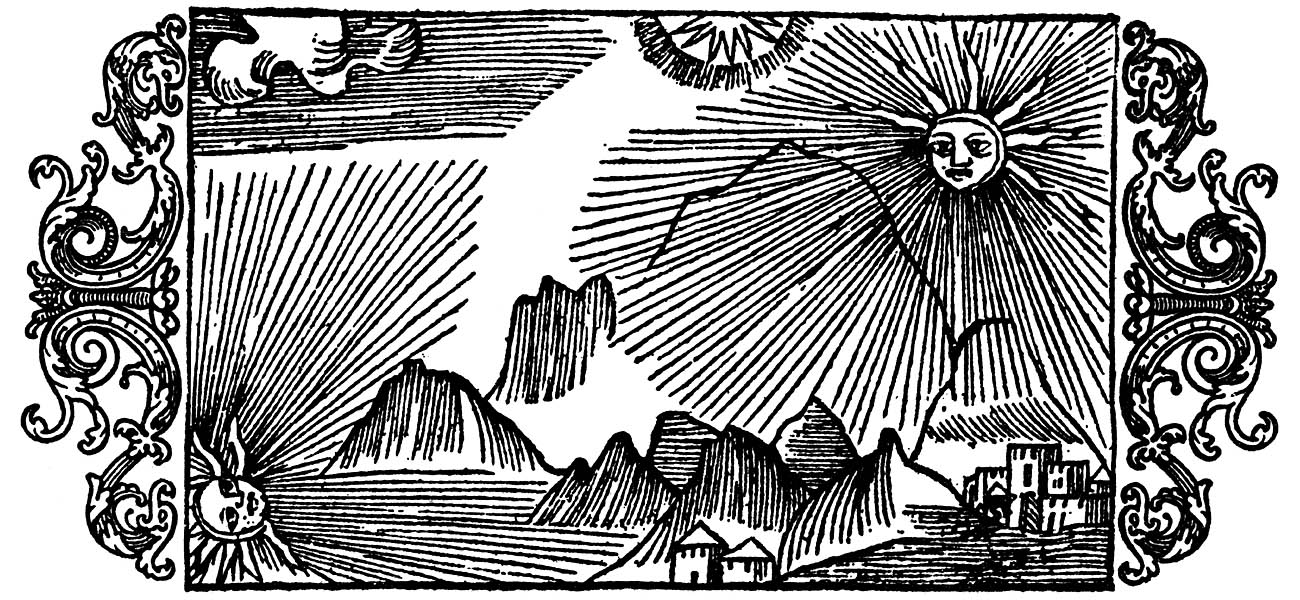
A Nordic environment with mountains or icebergs, showing the sun never setting during summer. O Magnus, Description of the Northern Peoples, 1555
Introduction
In this module students learn how we can know about past climate. The module explains how we combine the “archives of nature” and the “archives of society” to reconstruct climate for the time before modern measurements existed. Students also learn about the causes of the Little Ice Age – the most recent climatic shift before global warming.
Presentation
Questions and Answers
Why do different reconstructions of past climate in these presentations look different? Why don’t they all give the same results?
There are several reasons that reconstructions of past climates don’t all look the same: different reconstructions use different sources, which record aspects of the climate in different ways. Even scientists using the same natural archives, such as tree rings, might be looking at different proxies (indicators of past climate), such as the width of the tree rings or the density of their cells. Different reconstructions also use different methods to get climate information from their proxies. Moreover, different reconstructions measure different aspects of the climate, such as temperature and precipitation during different seasons of the year. Some focus on long-term changes and others on short-term variations; and some are local reconstructions, while others are regional. Current climate reconstructions of the LIA in the Nordic countries mostly agree with each other. However, no reconstruction is perfect or has all the information we need. That’s why it’s useful to look at multiple reconstructions to understand Nordic climate history.
How can we use old descriptions of weather in diaries or chronicles to reconstruct past climate?
Researchers in historical climatology have developed specialized ways to reconstruct past climates based on old descriptions. One important method is to convert descriptive information into ordinal indices for some aspect of the climate that we’re trying to reconstruct, such as winter temperature. Following this “index method,” researchers would gather reliable written historical sources about each season and rate its temperature on a scale of –3 to +3, for example. They might then look for periods when the written descriptions overlap with early thermometer measurements to calibrate the index values to degrees Celsius. Historical climatologists also focus on records of plant and ice phenology—that is, stages in the development of plants or the freezing and thawing of bodies of water that depend on seasonal temperature and precipitation. Phenological records often provide the most objective and reliable information about past climates in historical sources.
How old are the oldest measurements of temperature in the Nordic countries?
The earliest consistent thermometer records from the Nordic countries were made by Danish astronomer Ole Rømer (1644–1710). They cover the first decade of the 1700s and include the extremely cold winter of 1708–1709. Other early records include those of Anders Celsius (1701–1744), who invented a version of the Celsius scale that we still use today. From the 1800s to the early 1900s, national weather networks were developed to keep consistent records of temperature and precipitation in all of the Nordic countries.
Will we have another LIA?
The build-up of greenhouse gas emissions since the beginnings of industrialization in the 1800s will continue to affect the global climate for millennia. Even if all greenhouse gas emissions were stopped immediately, average temperatures would continue to rise. However, volcanic eruptions could still have a temporary cooling effect. If large eruptions like those of the LIA were to happen again during the 21st century, they would cool the Earth for up to a few years. Once the effects wore off, the planet would continue to warm again due to greenhouse gas emissions.
If the LIA was natural, how do we know that global warming is caused by humans?
While it is true that the Earth’s climate is never constant, there are several ways we know that current global warming is the result of greenhouse gas emissions and not just natural variability or forcings. First, the fact that gases such as carbon dioxide trap heat was already demonstrated in the 19th century. As early as the 1890s, Swedish chemist Svante Arrhenius (1859–1927) predicted that the burning of coal would warm the lower atmosphere. By the late 20th century, computer models started to make predictions about global warming, which have been fairly accurate. Second, satellite-based measurements show that the upper atmosphere is cooling while the lower atmosphere is warming—exactly what we would expect from greenhouse gases trapping heat, and the opposite of what we’d expect if solar activity were causing the change. Third, unlike the cooling of the LIA, there are no other known forces that could account for current global warming other than human greenhouse gas emissions. In fact the Little Ice Age is a good example to contrast natural and man-made climate changes. While many impacts look similar, such as the increased frequency of extreme events and reduced agricultural production, the current global warming accelerates at an unprecedented speed and is much more uniform than all natural fluctuations we know.
Activities
1. Climate and weather proxies.
What “climate proxies” do you encounter in your daily life? Are there plants or animals whose lifecycles help you identify whether the seasons are early or late? Are there bodies of water whose freezing and thawing indicate a cold winter or an early spring? Are there activities in your life whose timing depends closely on temperature or precipitation?
Discuss one of these proxies. What does it tell us about the climate (long-term averages of weather), and how well does it indicate climatic variability and climate change?
2. Evaluating historical sources about weather.
In December 1580, a Norwegian Bishop in Oslo included the following description in his sermon:
(Danish original)
Effterdi alting er nu saa gott som foruent och gaaen aff laffue. Saa att naar vij skulle haffue sommer og Solen skulle giffue sit skin og varme fra sig da haffue vij vinther. Och naar vij skulle haffue vinther da haffue Wy sommer, och endog Someren skulle vere lenger end vintheren som det haffuer i fordom tid veret. Saa er dog vintheren attligevel megit sterchere. Och det er end och saa megit underligt att endog Solen er os nu nermer end som hun vor i Ptolomei tid heden vid 9976 Thyske mile om vintheren naar hun er paa det laffuiste Saa vel ell som Sommeren naar hun er paa det høieste i sin Circkel. Saa giffuer hun dog icke sitt skin och varme fra sig, saa krafftelig som hun giorde paa den tid og tilforn.
(English translation)
Because everything now seems to be distorted and out of order. When summer should be here and the Sun should shine upon us with light and warmth, instead we have winter. And when we should have winter, we have summer. And even though the summer should be longer than the winter, as it was in past times, now the winter is much stronger. And it is strange that even though the sun is closer to us now than she was in the days of Ptolemy […] she nevertheless provides us with less heat and rays than she did in the past.
(Jens Nilssøn et al., To og Tredive Prædikener: holdt i Aarene 1578-1586, Norbok (Kristiania: Aschehoug, 1917), 464–67, https://urn.nb.no/URN:NBN:no-nb_digibok_2006113000049.)
What does this description tell us about the weather during that season? What other factors might have influenced the author’s description? What other information might we need to interpret the document?
3. Use ClimeApp to find a historical climate anomaly.
Watch the video below on how to use ClimeApp or check out this tutorial. Search the ClimeApp
website
to look for climate anomalies (top bar) that occurred during historical events you know. Can you find a link between anomalous climate and societal changes (revolts, wars, famines, migration)? Go to the sources tab and have a look at the original records. Discuss what kind of biases these records might contain and how (in-)accurate they might be.
4. Volcanic eruptions past and present.
During the LIA, there happened to be more large volcanic eruptions than we humans have experienced during the past 200 years. However, volcanoes keep erupting, including volcanoes in Iceland. For this activity, look up examples of volcanoes that have erupted in recent years
(https://volcano.si.edu/).
Find news stories about the impacts of these eruptions on climate and societies. How do these impacts compare to those during the LIA? What do they reveal about vulnerabilities and adaptations in today’s societies compared to those of the LIA? If it happened today, how might a very large eruption affect people in the Nordic countries and around the world?
Videos
In this video, we interview climatologists who study tree rings in the Norway. They tell us what it's like to work with these sources, and what we can learn from them about the LIA in the Nordic countries.
An introduction to ClimeApp: a new web-based interface using the Mode-RA database to reconstruct and map past climate.
Further Readings and References
Dominik Collet, Ingar Mørkestøl Gundersen, Heli Huhtamaa, Fredrik Charpentier Ljungqvist, Astrid Ogilvie and Sam White. “Introduction: Integrating, Connecting and Narrating Nordic Climate Histories.” In: Nordic Climate Histories (forthcoming) Impacts, Pathways, Narratives. Winwick: White Horse Press UK, 2025. https://doi.org/10.63308/63881023874820.book
Bell, W.T., and A.E.J. Ogilvie. “Weather Compilations as a Source of Data for the Reconstruction of European Climate during the Medieval Period.” Climatic Change 1 (1978): 331–48.
Brönnimann, Stefan, Christian Pfister, and Sam White. “Archives of Nature and Archives of Societies.” In The Palgrave Handbook of Climate History, edited by Sam White, Christian Pfister, and Franz Mauelshagen, 27–36. London: Palgrave Macmillan UK, 2018. https://doi.org/10.1057/978-1-137-43020-5_3.
Damodaran, Vinita, Rob Allan, Astrid E. J. Ogilvie, Gaston R. Demarée, Joëlle Gergis, Takehiko Mikami, Alan Mikhail, Sharon E. Nicholson, Stefan Norrgård, and James Hamilton. “The 1780s: Global Climate Anomalies, Floods, Droughts, and Famines.” In The Palgrave Handbook of Climate History, edited by Sam White, Christian Pfister, and Franz Mauelshagen, 517–50. London: Palgrave Macmillan UK, 2018. https://doi.org/10.1057/978-1-137-43020-5_34.
Esper, Jan, Elisabeth Duethorn, Paul J. Krusic, Mauri Timonen, and Ulf Buentgen. “Northern European Summer Temperature Variations over the Common Era from Integrated Tree-Ring Density Records.” Journal of Quaternary Science 29 (2014): 487–94. https://doi.org/10.1002/jqs.2726.
Fuentes, Mauricio, Riikka Salo, Jesper Björklund, Kristina Seftigen, Peng Zhang, Björn Gunnarson, Juan-Carlos Aravena, and Hans W. Linderholm. “A 970-Year-Long Summer Temperature Reconstruction from Rogen, West-Central Sweden, Based on Blue Intensity from Tree Rings.” The Holocene 28 (2018): 254–66. https://doi.org/10.1177/0959683617721322.
Gjerde, Marthe, Oddmund Løkensgard Hoel, and Atle Nesje. “The ‘Little Ice Age’ Advance of Nigardsbreen, Norway: A Cross-Disciplinary Revision of the Chronological Framework.” The Holocene, July 30, 2023, 09596836231185830. https://doi.org/10.1177/09596836231185830.
Grove, J. M. “The Initiation of the ‘Little Ice Age’ in Regions Round the North Atlantic.” Climatic Change 48 (2001): 53–82.
Kleemann, Katrin. A Mist Connection: An Environmental History of the Laki Eruption of 1783 and Its Legacy. Historical Catastrophe Studies / Historische Katastrophenforschung. De Gruyter, 2023. https://doi.org/10.1515/9783110731927.
Nordli, Ø., E. Lundstad, and A. E. J. Ogilvie. “A Late-Winter to Early-Spring Temperature Reconstruction for Southeastern Norway from 1758 to 2006.” Annals of Glaciology 46 (January 2007): 404–8. https://doi.org/10.3189/172756407782871657.
Norrgård, Stefan. “An Ice Breakup as in the Good Old Days’. Ice Jams in the Aura River, Turku, Southwest Finland, 1739–2024.” In Nordic Climate Histories: Impacts, Pathways, Narratives, edited by Dominik Collet, Ingar Mørkestøl Gundersen, Heli Huhtamaa, Fredrik Charpentier Ljungvist, Astrid E.J. Ogilvie, and Sam White. White Horse Press, 2025. https://www.whpress.co.uk/publications/2025/05/02/nordicclimatehistories/.