
Lesson 3 - Experiences
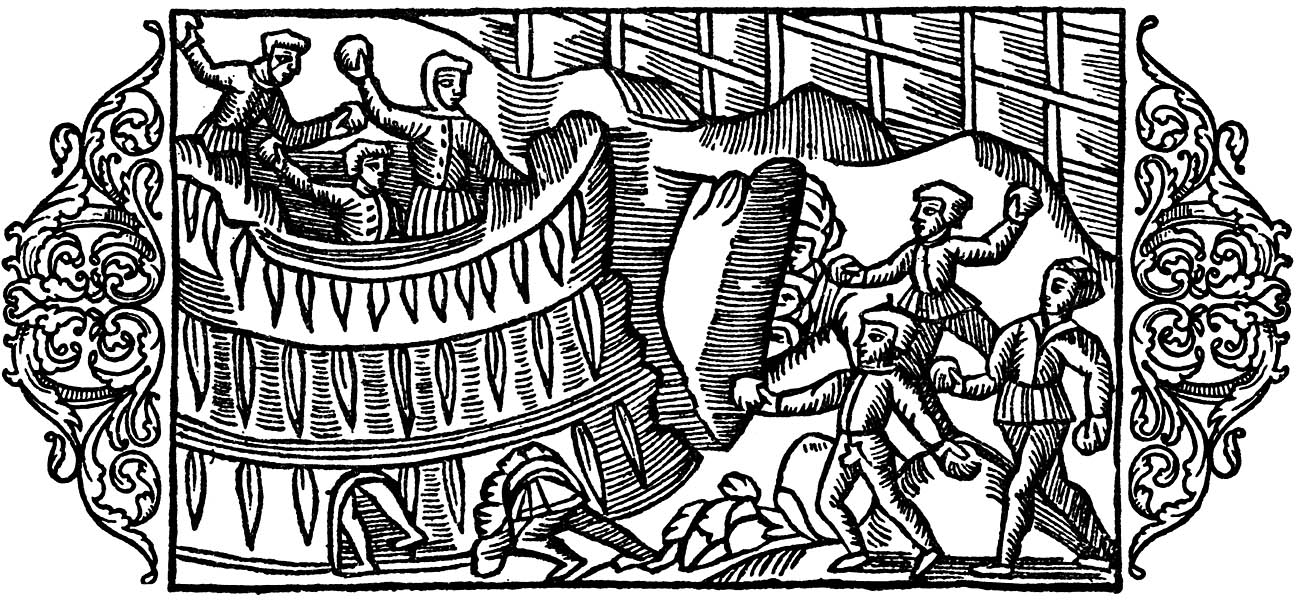
People in an ice castle engaged in a snowball fight. O Magnus, Description of the Northern Peoples, 1555
Introduction
In the 21st century, global networks of weather instruments measure the acceleration of global warming. But how did societies of past centuries make sense of extreme events and climatic change? This module explores how ordinary people experienced the LIA. It presents some ways of understanding the changing seasons, ranging from weather lore and literature to material culture and memory aids. The activities highlight the enduring significance of cultural adaptations during times of climate change.
Presentation
Questions and Answers
How did Icelanders survive the Little Ice Age when the Greenland settlements didn’t make it?
First, despite the name, Iceland is not as cold and icy as Greenland. The Viking Greenland colonies were limited to two small regions, where deep fjords provided some protection from the cold and enough grass for livestock to graze. By contrast, Icelandic colonies quickly spread around the island to different regions. The Icelandic population, though small, was larger and used more land than in Greenland. Moreover, Iceland was closer to mainland Europe and maintained contact with other Nordic countries throughout the Little Ice Age.
Longer distances and stormy seas cut off the Greenland colonies from trade during the 1400s. While both Greenlanders and Icelanders tried to adapt to their challenging environments by using marine resources, it seems Icelanders were more successful at earning a living from fishing, which eventually became the mainstay of Iceland’s economy. Iceland was also uninhabited when the first European colonists arrived, but there were already people living in Greenland, including ancestors of today’s Greenlanders (Kalaallit).
Finally, it’s important to remember that even though Icelanders survived, they also faced some very difficult times—including famines, conflicts, and epidemics that killed large parts of the population—before modern commerce, industry, and tourism brought prosperity to the country.
How well did people remember past weather and climate during the LIA? Did those memories help them prepare?
Based on a mix of evidence from different European sources, it seems that communities during late medieval and early modern times preserved a social memory of the weather—that is, a living memory passed down through stories, activities, and traditions—that reached back perhaps two or three generations. Often, when early modern sources describe a winter as “the coldest winter in memory,” we find that it was at least the coldest winter of the previous 50–60 years.
People could rely on local environmental knowledge—when rivers or lakes froze, when the snows melted, or when the trees put out leaves—to compare seasons in different years. In some cases, cultural memory—memory inscribed in writings, art, or the built environment—helped recall past extreme weather and disasters. High water marks on old buildings and “hunger stones” placed in dried-out river beds served as physical reminders of climate variability.
Swiss historian Christian Pfister has argued that these forms of social and cultural memory helped build “risk cultures”: communities that remembered how to respond to repeated disasters and reduce their exposure and vulnerability to climate variability and extreme weather.
That passage from Shakespeare was really difficult! Could you explain what it means and what it has to do with the Little Ice Age?
The lines come from act 2, scene 1 of A Midsummer Night’s Dream. Titania is saying that the seasons have become chaotic—flowers and frosts appearing out of season—so that people can’t tell the seasons apart anymore. The dialogue continues by describing the consequences: ruined fields, failed harvests, and sick flocks.
The seasons alter: hoary-headed frosts … the mazèd world / By their increase now knows not which is which
In the play, this chaos functions as a metaphor for disorder among the characters until it is resolved. But historical sources from England in the mid-1590s—the period when the play was written—describe unusual and extreme weather conditions: exceptionally cold summers (likely related to a large volcanic eruption in 1595) and shortages, epidemics, and even famine in parts of the country. In that context, the play can be read as a kind of escapism during a time when summers were disappointing or miserable.
Activities
1. Weather lore.
Before the modern science of weather, people often relied on “weather lore”—traditional local knowledge about weather and environments. Some collections of weather lore were even published as books or pamphlets, such as Die Bauernpraktik (1508), which was translated into Nordic languages. The beginning of the Finnish edition reads as follows:
https://www.doria.fi/handle/10024/147697
Jos joulu-aattona ja joulu-yönä on selkiä ilma, ilman sadetta ja tuulta, niin sinä wuonna tulee hyvä wuosi, ja joka henki saa kyllä elatuksensa; mutta jos silloin tuulee ja sataa, niin se merkitses kato-wuotta. Jos tuuli on Idässä, tulee tauti Kuninkoiden ja Ruhtinoiden wieraaksi; kuolema ottaa myös heistä monta pois. Jos tuuli on pohjoisesta, ole silloin ilossas; sillä se merkitsee hyvää wuotta, mutta jos se on Merestä, taikka Etelästä, niin se merkitsee tautia.
(Translation: If on Christmas Eve and during Christmas Night the weather is clear, without rain or wind, then that year will be a good year, and everyone will have sustenance enough; but if it is windy and rainy then, it foretells a year of dearth. If the wind is from the east, disease will visit kings and princes; death will also take many of them away. If the wind is from the north, then rejoice; for it signifies a good year, but if it comes from the Sea or from the South, then it signifies disease.)
Do you or your family/community still use some kinds of weather lore? Could this kind of traditional ecological knowledge still be useful today as we face climate change?
2. A new “History of the Northern Peoples”.
Almost five centuries ago, Olaus Magnus tried to explain the significance of cold winters for Nordic peoples for an audience in southern Europe. His famous account, The History of the Northern Peoples, included descriptions of the climate such as the following:
“Cold burns the eyes of animals and stiffens their hairs. Cold makes wild beasts seek out men's dwellings, wanting to relieve their hunger… Cold makes wolves fiercer than normal… Cold allows fish to be kept fresh for five or six months without salt… Cold allows games and most delightful shows to be held on the ice… Cold causes inns to be set up, markets to be held, and wars to take place on frozen waters. [etc.]” (from History of the Northern Peoples, book I, chapter 19)
Imagine you are in Italy, trying to explain the significance of a cold climate in your home country to an Italian who has never traveled up north. What activities, natural phenomena, benefits, and challenges would you describe? What pictures might you show? How would your description resemble or differ from Olaus Magnus’s (you can see his pictures here)? What do those similarities and differences reveal about changes in climate, culture, technologies, and societies since the Little Ice Age?
3. Primstav activity (after the workshop video).
Watch the primstav workshop video (below) and repeat the activity in class. Discuss:
What activities define the seasons for you and your classmates? How do they illustrate climatic and cultural changes since the LIA?
4. Making sense of disaster – a mother killing her starving children.
Read or listen to the ballad The Norwegians’ Sorrow and Lament (link to transcript and translation about the 1770s anomaly and famine). You can use:
(1) a transcription and translation of the text,
(2) scans of the original print,
or (3) listen to the audio version (in Norwegian) below.
Discuss: Who is blamed for the tragedy—climate/nature, God, neighbours, tradesmen, the King? What does this say about how people made sense of climate extremes? How does this compare to who we hold responsible for climate change today?
Videos
Further Readings and References
Anon., The Norwegians’ Sorrow and Lament over The Grievous and Costly Time … 1772. Norwegian original / Transcription and English translation [XXX].
Barlow et al. “Interdisciplinary Investigations of the End of the Norse Western Settlement in Greenland.” The Holocene 7 (1997): 489–99. https://doi.org/10.1177/095968369700700411.
Brandtzæg, Siv Gøril. Singing the News in the Eighteenth Century. 2019. http://hdl.handle.net/11250/2646894.
Dugmore et al. “Cultural Adaptation, Compounding Vulnerabilities and Conjunctures in Norse Greenland.” PNAS 109 (2012): 3658–63. https://doi.org/10.1073/pnas.1115292109.
Jackson, Dugmore & Riede. “Legacies of Childhood Learning for Climate Change Adaptation.” Global Environmental Change 87 (2024): 102878. https://doi.org/10.1016/j.gloenvcha.2024.102878.
Magnus, Olaus. Description of the northern peoples [1555]. Hakluyt Society, 1996.
Meyer & Riede. “Playing to Survive: Children and Innovation During the Little Ice Age in Greenland.” European Journal of Archaeology (2024). https://doi.org/10.1017/eaa.2024.36.
Pfister. “Climatic Extremes, Recurrent Crises and Witch Hunts…” Medieval History Journal 10 (2007): 33–73.
Pfister & White. “Evidence from the Archives of Societies: Personal Documentary Sources.” In The Palgrave Handbook of Climate History (2018). https://doi.org/10.1057/978-1-137-43020-5_5.
White, Sam. A Cold Welcome. Harvard University Press, 2017.