
Lesson 6 - Lessons
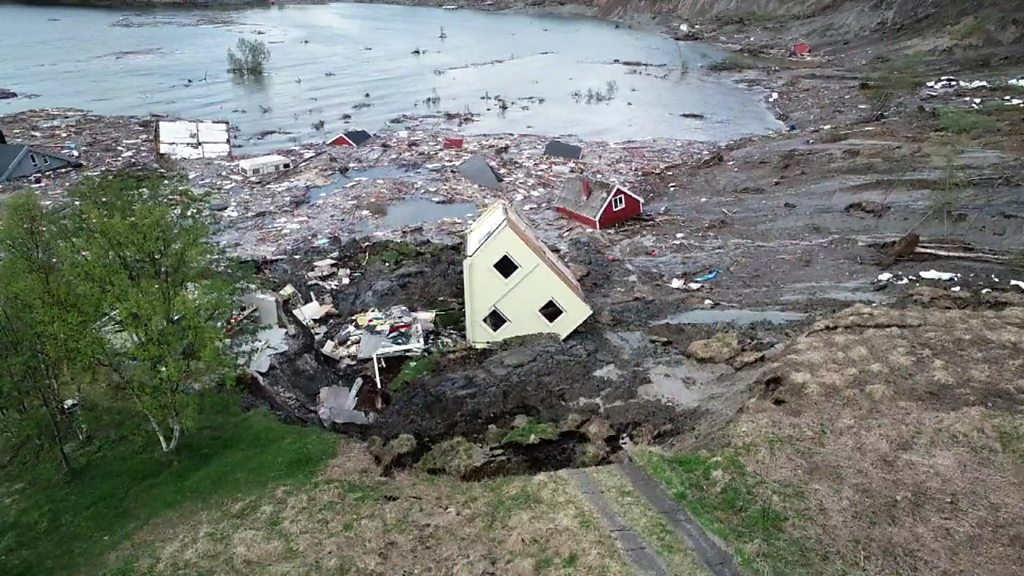
Homes swept into the sea by a landslide near Alta, Norway, in 2020.
Introduction
This course has explored ways that Nordic countries coped with ‘climate crisis’ in the Little Ice Age. In this final module we consider lessons for societies confronting global warming today. Here, the course moves into the social sciences, looking at factors that affect how well societies adapt to a changing climate. We see that many underlying issues today are remarkably similar to those of the Little Ice Age. We will hear from experts working with climate adaptation today and engage in the politics of adaptation in a debate activity.
Presentation
Questions and Answers
Are Nordic countries vulnerable to climate change?
On the one hand, some argue that Nordic countries are less vulnerable than other regions to climate change thanks to their relative wealth, diverse economies, cultures of living with harsh weather, and well-functioning institutions and infrastructures. Global warming may even make these lands more productive in terms of longer growing seasons for crops. With Nordic lands still rising from the melting of ice age glaciers (isostatic rebound), some argue that sea level rise will be less of a problem here than elsewhere in the world. On the other hand, high latitudes are expected to undergo the world’s fastest warming, with many regions having already experienced more than 1.5 degrees celsius of warming since the 1970s and Arctic places such as Svalbard on average 5-6 degrees warmer since the 1970s. This warming has disrupted rainfall patterns and created conditions for melting of permafrost or glaciers and more destructive storms. Moreover, most Nordic countries are net importers of food, producing fewer than half of their calories domestically, which leaves them vulnerable to climate change impacts on food and feed production elsewhere in the world. And within Nordic countries themselves, groups such as immigrant communities and the elderly are much more likely to be exposed and vulnerable to climate impacts like heat waves.
Are Nordic economies less vulnerable than during the Little Ice Age because they depend less on agriculture?
People in the Nordic countries rarely depend on subsistence agriculture, so bad weather is unlikely to create immediate food shortages. Nevertheless, the impacts of weather will be felt in other sectors. Hydro-electricity production must plan for changing rhythms of rainfall, which can lead to a less predictable power supply. Transportation and urban infrastructures will face damage. Sectors such as forestry will have to adapt to changing seasons and weather conditions. Moreover, the Nordic countries will be affected by the economic impacts of a changing climate in Europe and other trading partners.
Are Nordic societies taking action for climate adaptation?
Nordic governments have generally been proactive in climate change mitigation and adaptation. Networks of experts in the Nordic region—for example, the bi-annual Nordic Climate Change Adaptation (NOCCA) conference—together explore ways to predict and adapt. Nevertheless, adaptive capacity is uneven—just as it was during the Little Ice Age. Large cities often have significant resources to spend on multiple solutions, from green areas to public transport systems, while small rural municipalities may not have the resources to take steps at all. Moreover, important Nordic industries such as oil also contribute to global warming. These industries limit mitigation efforts and will face pressure to change their practices or stop altogether as global warming accelerates.
Is climate change political in Nordic countries?
Yes, themes of climate adaptation and mitigation are the source of heated political debates in the Nordic countries. While governments’ policy positions on climate change are often quite clear, citizens in some Nordic countries can be quite skeptical that there is such thing as human-caused global warming or that climate change will affect them personally. In Norway, for example, around one in four people are climate change skeptics. Therefore, elections may be influenced by issues of climate change, adaptation, and mitigation measures.
Activities
Debate activity
Climate mitigation and adaption can demand changes to the ways we do things and how we distribute resources. These changes can bring clashes between different worldviews, lifestyles, and values, and democratic societies need to debate the best ways to move forward.
In this activity, groups of learners formulate arguments for or against a proposition in a formal debate.
Competitive debating has a long tradition in schools, with the World Schools Debating Championships running since 1988. There are multiple resources for how to organise a debate (see e.g. https://www.wsdcdebating.org), but here we outline one way to run a relatively short, simple and open format debate:
- The teacher divides the class into groups of six, which then split into two teams of three. Groups will be given a proposition or political position to debate, with one team arguing in favour of the proposition (the affirmative team), and the other team arguing against it (the negative team). Students can divide into teams themselves, and decide on which order each of the three team members will speak. Each team member must speak, and can only speak once. Alternatively the teacher can assign teams and speaker order or select randomly by pulling a card from a hat (e.g., a red card with a ‘2’ might indicate a student is in the negative team and speaks second).
- The teacher defines the rules and format of the debate BEFORE revealing the proposition at the very end.
- First, teams will be given 12 minutes to plan their arguments for or against the proposition and decide which speaker will raise which arguments. Team members will each only have three minutes to speak.
- The debate runs according to the following speaking order:
- The first speaker of the affirmative team starts the debate, outlines the proposition, and presents their case.
- The first speaker of the negative team presents their case, and offers some rebuttal to affirmative team’s case.
- The second speaker of the affirmative team upholds their case, and rebuts the case of the negative team.
- The second speaker of the negative team upholds their case and rebuts the case of the affirmative team.
- The third speaker of the affirmative team summarises their case and rebuttals, with no new arguments.
- The third speaker of the negative team summarises their case and rebuttals, with no new arguments.
- Speakers are encouraged to be argumentative and speak forcefully for their case and against the opposition's case while remaining respectful and polite. Speakers may be interrupted to clarify points of information, but this does not count against their time, and they may choose whether or not to answer.
- The above instructions can be presented in pptx or sent to students in advance.
- Instructors may add a seventh member to each group to act as a ‘judge’ and ensure that group members keep to the stipulated rules and timings. The judge decides at the end which team wins and which arguments were most persuasive.
- Finally, the proposition is presented. The teacher may come up with their own, but we suggest one here: ‘Nordic societies are not vulnerable to the impacts of climate change’.
Disaster Memory
Scholars in environmental history and disaster studies have found that collective memory of past disasters and responses helps prepare communities to respond to future disasters, such as flooding. Collective memory includes both social memory—living memory passed down through stories, traditions, and shared activities—as well as cultural memory, preserved in writings, images, and the built environment.
Where do you find social or cultural memory of disasters in your community? What kind of disasters are remembered (or forgotten)? Are any of them old disasters from the LIA? Are any of them recent disasters, such as forest fires, related to global warming? How might memories of these disasters help your community prepare if they happen again?
Videos
Further Readings and References
O’Brien, K. L., & Leichenko, R. M. (2000). Double exposure: assessing the impacts of climate change within the context of economic globalization. Global Environmental Change, 10(3), 221-232. https://www.sciencedirect.com/science/article/pii/S0959378000000212
Sygna, L., Eriksen, S. E., O’Brien, K., & Næss, L. O. (2004). Climate change in Norway: Analysis of economic and social impacts and adaptations. CICERO report. https://www.researchgate.net/profile/Karen-Obrien-13/publication/242189909_Climate_change_in_Norway_Analysis_of-economic-and-social-impacts-and-adaptations/links/53dfea7e0cf2a768e49d1b1a/Climate-change-in-Norway-Analysis-of-economic-and-social-impacts-and-adaptations.pdf
Anisimov, A., Magnan, A. K., Hawke, A., Vallejo, L., Benzie, M., Klein, R. J., ... & Harris, K. (2023). Transboundary climate risks: definition and recent trends. The Institute for Sustainable Development and International Relations (IDDRI) in April 2023. https://repository.uantwerpen.be/docman/irua/2c0c30motoMd1#page=19
Hulme, M. (2009). Why we disagree about climate change: Understanding controversy, inaction and opportunity. Cambridge University Press.