
Lesson 5 - Responses
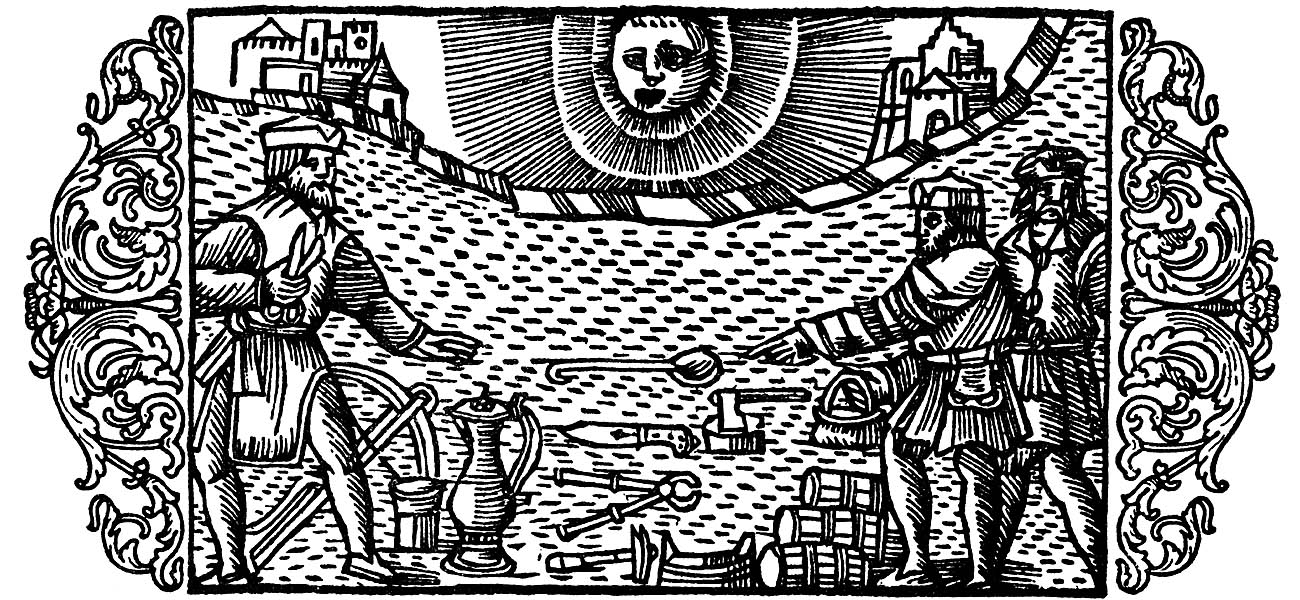
A frost market on ice where tools, weapons and supplies are traded. O. Magnus, Description of the Northern Peoples, 1555
Introduction
People often feel overwhelmed by the scale of climate change. Can we learn something from the way people responded during the Little Ice Age? This module illustrates that even in a pre-industrial society several hundred years ago people found creative solutions to challenges not unlike the ones we face. The examples here cover new foods, changing welfare systems, political reform and agricultural adaptation. None were introduced without conflict, but several proved immensely successful and might encourage us to broaden our repertoire of responses today.
Presentation
Questions and Answers
Before potatoes, what kinds of foods did people eat when the crops failed?
In most preindustrial societies, people were prepared for one or maybe two bad harvests. It was usually when the harvests failed completely or several poor growing seasons came in a row that people became desperate. Farmers might start by eating whatever food they had stored away or spending any money they had saved (which was often very little). They might then eat their livestock and other domestic animals, such as oxen. Wild foods could be foraged from the forests, including berries, nettles, wild sorrel, and edible mushrooms such as chanterelles and porcinis (ceps). So-called “famine foods” included more fibrous plants and concoctions such as “bark bread” (see the video). Families and communities relied on collective memory of past hard times to know which of these foods was safe and where they might be found.
Besides potatoes, how else did agriculture change during the 1700s and 1800s?
This period is sometimes called an “agricultural revolution,” but the changes were often gradual and piecemeal. Wealthier and more industrious farmers, particularly in Sweden and Denmark, experimented with new crop rotations, cover crops, and fertilizers. Although people at the time didn’t understand the chemistry, these experiments helped soils preserve their nutrients without long periods of fallow. In Finland, however, large parts of the country were still used for swidden agriculture into the 1700s, and in Iceland, more people relied on their sheep and cattle or fishing. Scientific breeding of livestock helped raise outputs of wool and dairy, but yields were still very small compared to those today. Some fruits and vegetables were imported from around the world, including Sweden and Denmark's overseas colonies. Apple, pear, and cherry trees were brought to gardens in Scandinavia and even Finland—although many would die in the exceptional cold of the 1690s and the winter of 1708–09.
How did granaries work? Did they keep people from going hungry after harvest failures?
Granaries were buildings to hold grain and keep it elevated, dry, and safe from mice and worms. Before modern construction methods and refrigeration, it was difficult to build granaries that could hold enough grain or preserve it long enough to compensate for failed harvests. Nevertheless, granaries could still play important roles in preventing famine. By purchasing grain when harvests were abundant and selling it when harvests were poor, granaries could prevent sudden swings in prices and discourage speculators from trying to hoard grain and drive up the price for a profit. Granaries could also loan out seed grain. In other words, in really bad times, farming families might eat up the grain that they had saved to plant the next year. Granaries could provide those seeds, so that farmers could plant again the following year and then pay back the granary.
Why didn’t states do more to help their citizens? Why did they only start building granaries and organizing relief commissions in the 1700s?
States in the late middle ages and early modern times were often very limited in what they could do to help their citizens. Administration was rudimentary; paper was expensive; few people could read, write, or do arithmetic; and there were no censuses to keep track of populations. Roads were poor, populations were dispersed, and many communities were hard to reach. Most people spoke local dialects rather than the national language.
Moreover, ideas about state and society took time to change. In late medieval and early modern times, Nordic society was viewed as comprising four estates. The peasants—the great majority of the population—were expected to work the land to feed the other three estates: the nobility, the clergy, and the burghers, who fought, prayed, and engaged in crafts and commerce, respectively. The main business of rulers (monarchs and their councils) was to protect the realm and engage in war. In medieval times, the Catholic Church was largely responsible for (basic) education and charity. Nordic states took over these roles only partially and gradually following the Protestant Reformation of the 1500s.
Over time, Enlightenment ideas helped focus the attention of rulers on the welfare of their subjects. In part, this came out of a genuine concern for their well-being. In part, rulers realized that they needed larger and healthier populations to pay taxes and to fight in increasingly large and expensive wars. Meanwhile, improvements in “information technology”—including the printing press, cheaper paper, modern accounting and statistics, and census records—meant states could learn more about their subjects and intervene more in their lives and livelihoods, both for better and for worse.
Activities
1. Emergency foods.
Hopefully, people in the Nordic countries today are safe from the kinds of famines that afflicted people in the LIA. Nevertheless, emergency preparedness remains an important part of safety in the event of natural hazards, epidemics, or foreign attack.
If your household faced an emergency today, what foods would you have on hand, and how long would they last? Could you identify safe and nutritious wild foods? Which ones?
2. Homes in the LIA.
Take a look at some of these rural buildings from different regions of Norway built during the 1300s–1700s, which have been reconstructed at the Norwegian Museum of Cultural History.
And Sámi regions
How do these different buildings—homes, farmhouses, and storage buildings—illustrate different adaptations to cold climates during the LIA? What would it have been like to live in one of these buildings during long, cold winters?
3. Nordic communities in North America.
There were natural climate changes during the LIA, and there are much faster anthropogenic climate changes during the present global warming. Yet some of the biggest and most challenging “climate changes” have been those that people face when they move to new countries with different climates.
For this project, first do some research to find out where Nordic emigrants settled in North America during the late 1700s–early 1900s. Then look for information about the weather, seasons, and extreme events in those regions. How was the climate different from those parts of the Nordic countries where most people emigrated? What kinds of weather, seasonal changes, or extreme events might have been especially surprising and challenging for Nordic emigrants in the New World? How were Nordic livelihoods and experiences adapted—or maladapted—to the environments, agriculture, and industries in these parts of North America?
Videos
In these videos, archaeologist and climate historian Ingar Gundersen shows us how to make bark bread, and climate historian Astrid Ogilvie discusses famine, adaptation, and survival in Iceland.
Further Readings and References
Barton, H. Arnold. Letters from the Promised Land: Swedes in America, 1840-1914. University of Minnesota Press, 1975.
Barton, H. Arnold. Scandinavia in the Revolutionary Era, 1760-1815. University Of Minnesota Press, 1986.
Collet, Dominik, Ingar Mørkestøl Gundersen, Heli Huhtamaa, Fredrik Charpentier Ljungqvist, Astrid E. J. Ogilvie, and Sam White. “Integrating, Connecting and Narrating Nordic Climate Histories.” In Nordic Climate Histories: Impacts, Pathways, Narratives, edited by Dominik Collet, Ingar Mørkestøl Gundersen, Heli Huhtamaa, Fredrik Charpentier Ljungvist, Astrid E.J. Ogilvie, and Sam White. White Horse Press, 2025. https://www.whpress.co.uk/publications/2025/05/02/nordicclimatehistories/.
Degroot, Dagomar. The Frigid Golden Age: Climate Change, the Little Ice Age, and the Dutch Republic, 1560–1720. Cambridge University Press, 2018.
Gundersen, Ingar Mørkestøl. “Integrating Agricultural Vulnerability and Climate Extremes. Eighteenth-Century Norway through the Works of Jacob Nicolaj Wilse (1735–1801).” In Nordic Climate Histories: Impacts, Pathways, Narratives, edited by Dominik Collet, Ingar Mørkestøl Gundersen, Heli Huhtamaa, Fredrik Charpentier Ljungvist, Astrid E.J. Ogilvie, and Sam White. White Horse Press, 2025. https://www.whpress.co.uk/publications/2025/05/02/nordicclimatehistories/.
Kerr, Sarah. “The Moving Manors and Adaptation in Sixteenth Century Denmark.” In Nordic Climate Histories: Impacts, Pathways, Narratives, edited by Dominik Collet, Ingar Mørkestøl Gundersen, Heli Huhtamaa, Fredrik Charpentier Ljungvist, Astrid E.J. Ogilvie, and Sam White. White Horse Press, 2025. https://www.whpress.co.uk/publications/2025/05/02/nordicclimatehistories/.
Kleveland, Kristine. “Glacier Poetry in Norwegian Literary Historiography.” In Nordic Climate Histories: Impacts, Pathways, Narratives, edited by Dominik Collet, Ingar Mørkestøl Gundersen, Heli Huhtamaa, Fredrik Charpentier Ljungvist, Astrid E.J. Ogilvie, and Sam White. White Horse Press, 2025. https://www.whpress.co.uk/publications/2025/05/02/nordicclimatehistories/.
Lundstad, Elin, Stefan Norrgård, and Astrid E.J. Ogilvie. “The Development of Meteorological Institutions and Early Instrumental Climate Data in the Nordic Countries.” In Nordic Climate Histories: Impacts, Pathways, Narratives, edited by Dominik Collet, Ingar Mørkestøl Gundersen, Heli Huhtamaa, Fredrik Charpentier Ljungvist, Astrid E.J. Ogilvie, and Sam White. White Horse Press, 2025. https://www.whpress.co.uk/publications/2025/05/02/nordicclimatehistories/.
McNeill, William H. “How the Potato Changed the World’s History.” Social Research 66 (1999): 67–83.
Reinfjord, Kristian. “Architectural Climate Change Adaptions in Little Ice Age Norway c. 1300–1550.” In Nordic Climate Histories: Impacts, Pathways, Narratives, edited by Dominik Collet, Ingar Mørkestøl Gundersen, Heli Huhtamaa, Fredrik Charpentier Ljungvist, Astrid E.J. Ogilvie, and Sam White. White Horse Press, 2025. https://www.whpress.co.uk/publications/2025/05/02/nordicclimatehistories/.
Starlander, Jakob. “The Impact of Wildfire and Climate on the Resilience and Vulnerability of Peasant Communities in Seventeenth-Century Finland.” In Nordic Climate Histories: Impacts, Pathways, Narratives, edited by Dominik Collet, Ingar Mørkestøl Gundersen, Heli Huhtamaa, Fredrik Charpentier Ljungvist, Astrid E.J. Ogilvie, and Sam White. White Horse Press, 2025. https://www.whpress.co.uk/publications/2025/05/02/nordicclimatehistories/.