
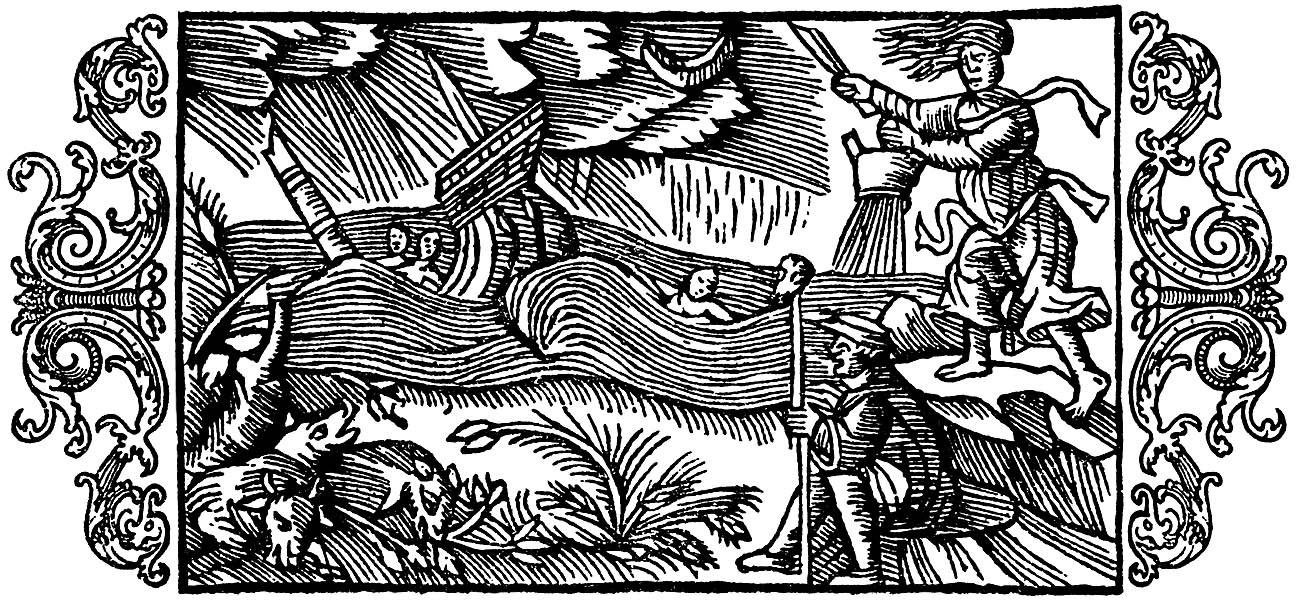
Witches conjuring up a storm. O. Magnus, Description of the Northern Peoples, 1558.
Introduction
Did the Little Ice Age influence history at large—that is, the wars, social movements, or cultural transformations that usually fill the pages of our history textbooks? This lessons explains ways to analyze possible influences of climate on politics, economies, and culture. Nordic societies experienced very different outcomes compared to each other and to their European neighbors, ranging from cooperation to conflict and from adaptation to appropriation of climatic change. The modules introduces a range of factors that made societies more vulnerable or more resilient to environmental stress.
Presentation
Questions and Answers
Why did some cold places (like the Netherlands) prosper during the Little Ice Age while some warm countries (like Turkey and Spain) suffered crises?
First, the LIA didn’t just involve cooling. There were also periods of major drought, particularly in Mediterranean countries such as Spain and Turkey. Sometimes, their vulnerabilities to drought were even greater than vulnerabilities to cold in the North. Moreover, extreme cold can affect southern countries, too. For example, freezing winters contributed to sickness and death among livestock in Spain and the Ottoman Empire (which included today’s Turkey). Even the coldest winters of the LIA in the Mediterranean probably weren’t as cold as Nordic winters, but on the other hand, people in Mediterranean countries weren’t as prepared for those extremes.
Just as important were differences in adaptation and resilience. Some northern countries such as the Netherlands already had more diversified agriculture and economies when the worst cold of the LIA came during the late 1500s–1600s. While the Spanish and Ottoman empires were big and diverse, their governments at the time depended a lot on taxes and resources they could gather from farmers just in Castille and in parts of Anatolia and the Balkans, respectively. Farmers in these places relied mainly on a single harvest of winter wheat or barley each year.
While a lot has changed since the LIA, we can expect a similar pattern of impacts as the world faces global warming. Already hot countries will face more disasters from heat waves, extreme precipitation, and drought, while cold countries will enjoy some benefits from warmer summers and milder winters. Nevertheless, all parts of the world—the Nordic countries included—will be at risk from unexpected and unfamiliar hazards. Extreme heat could be especially deadly for countries that haven’t faced it before or haven’t prepared for it. The countries that prosper will probably be those that are more adaptable and resilient, whether they are hot or cold countries.
Does climate change still cause violent conflicts?
Concerns that global warming will cause more violence and wars has encouraged a lot of recent research into links between climate and conflict. The results are mixed. On the one hand, it’s important to remember that climate doesn’t start wars—people do. Moreover, the connections between climate- or weather-related hazards and conflicts are indirect: they depend on effects on agriculture, prices and employment, and population displacement. In other words, we’re more likely to see connections between climate and conflict where a lot of people rely on farming, where weather has a big impact on the economy, or where disasters have forced a lot of people out of their homes and into cities or neighboring countries. Conflict is also more likely in places where governments are unstable and there is a recent history of war or civil conflict.
On the other hand, climate- and weather-related disasters definitely affect the location and timing of conflicts and the people involved. Furthermore, there seem to be some consistent pathways between these disasters and the outbreak or intensification of conflicts. States might take advantage of disasters to invade other countries or to suppress dissent in their own borders. States already at war might use disasters tactically, to attack opponents when they are weak or distracted. Or else insurgents might take advantage of disasters to try to bring down the government. Governments might also encourage or allow violent scapegoating for disasters, to deflect attention or blame. What is interesting is that we find all of these patterns both during the LIA and still today.
Of course, connections between climate- or weather-related disasters and conflict are not inevitable. Disasters can also be critical moments for international intervention, peace-making, and cooperation. Ultimately, it is people who determine how climate shapes history.
How would history have been different if the Little Ice Age had never happened at all?
A tough question! Historians are usually very reluctant to answer these kinds of “what if?” questions. History usually focuses on facts rather than speculation. That said, let’s go ahead and speculate a little!
Basically, we can understand the influence of the LIA on history in terms of contingencies and structures. To simplify, contingencies are the individual accidents of history. Sometimes accidents of weather could have big historical consequences. But for Denmark’s extremely cold winter of 1657–1658, Swedish forces couldn’t have invaded Zealand, Denmark wouldn’t have given up so many territories to Sweden, and Denmark probably wouldn’t have taken its sudden turn to royal absolutism in 1660. Similarly, if Europe hadn’t had such a terribly cold winter in 1708–1709 (by some measures, the coldest of the last millennium) then Charles XII might have saved Sweden from its catastrophic defeat in the Great Northern War. The region would have been saved from horrendous suffering from continued fighting, hunger, and disease; and Sweden might have kept its place as a great power in Europe.
Yet before we get carried away with these contingencies, we need to remember the power of structures: the big forces of history including demography, environments, and the evolution of ideas and technologies. Relative to Denmark, the kingdom of Sweden in the 1600s was a large country with territories around the Baltic, and important resources in iron. It didn’t just depend on accidents of weather for victory throughout the Danish–Swedish conflicts of the period. At the same time, Sweden was relatively poor with a small population compared to great powers such as France and Russia, and Sweden would have struggled to keep its territories and status even with more success on the battlefield in 1709. Political systems were debated all across Europe, and most kingdoms sooner or later experimented with the French-style royal absolutism adopted in Denmark in 1660. As with its impact on witch trials (described in the presentation accompanying this lesson), the influence of the LIA on these developments was more about location, degree, and timing, rather than whether they happened at all.
Nevertheless, we should also consider the LIA as a structural force in the history of the Nordic countries. Taken individually, weather-related disasters of the LIA were just accidents; but their cumulative effect over centuries was significant. The LIA almost certainly set back population growth and consequently urbanization and industrialization in the Nordic countries, both in absolute terms and relative to countries like England, France, or Germany. It was a particular disadvantage to Finland and Iceland (if we include Iceland’s bad sea-ice years and volcanic eruptions as part of the LIA). At the same time, the slower population growth among farmers probably helped preserve Sámi communities from further colonialism. Migration from climate hazards created links among Nordic populations, and emigration overseas eventually left a legacy in millions of descendants in North America (see lesson 5). Community and public responses to disasters may have also contributed to the development of Nordic democracies and welfare states. But now, we are probably going too far into speculation…
Activities
- Analyzing images.
The invasion of the Swedish army across towards Copenhagen in 1658 was captured in a contemporary painting by the artist Johann Philipp Lemke (1631–1711). The painting is now held in Sweden’s National Museum in Stockholm. You can find a high-resolution scan here.
View the image closely. How does the artist depict the exceptional cold of the winter? How does he emphasize heroic and also tragic aspects of the battle and the crossing of the frozen Belt? How does this depiction of the Little Ice Age compare with famous European winter landscapes paintings of the period, including Pieter Bruegel’s Hunters in the Snow (1565) and Hendrik Avercamp’s On the Ice (1610)? What can we learn about the climate and cultural reactions from images like these?
- Disasters and politics.
Climate- and weather-related disasters continue to have political consequences in the 21st century. Successful responses to disasters can help leaders and institutions demonstrate their effectiveness; yet poor handling of disasters can lead to political unpopularity or protests. Some disasters invite international cooperation while others fuel mistrust and animosity. For this exercise, look for recent examples of major climate- and weather-related disasters in the news, and discuss the following questions: Which politicians, agencies, or institutions are blamed for the damage? Who is praised or blamed for a good or bad response to the disaster? What domestic and international political consequences might follow from the disaster? And how do those compare to the consequences of disasters in the Little Ice Age?

_-_Google_Art_Project.jpg)

Videos
In this video, we interview researcher Wanda Marcussen about witch trials in Little Ice Age Norway.
Further Readings and References
Collet, Dominik.. “Abusing Climate: The 1770s Anomaly and the First Partition of Poland–Lithuania.” Acta Historica Tallinnensia. ISSN 1406-2925. https://doi.org/10.3176/hist.2023.2.02
Degroot, Dagomar. “War of the Whales: Climate Change, Weather and Arctic Conflict in the Early Seventeenth Century.” Environment and History 26 (2020): 549–77. https://doi.org/10.3197/096734019X15463432086801.
Frost, Robert I. The Northern Wars: War, State and Society in Northeastern Europe, 1558-1721. Modern Wars in Perspective. Harlow, England ; Longman, 2000.
Gøbel, Erik. “Colonial Empires.” In The Cambridge History of Scandinavia: Volume 2: 1520–1870, edited by E. I. Kouri and Jens E. Olesen, 2:279–309. Cambridge: Cambridge University Press, 2016. https://doi.org/10.1017/CHO9781139031639.018.
Parker, Geoffrey. Global Crisis: War, Climate Change and Catastrophe in the Seventeenth Century. Yale University Press, 2013.
Parker, Geoffrey. “History and Climate: The Crisis of the 1590s Reconsidered.” In Climate Change and Cultural Transition in Europe, edited by Claus Leggewie and Franz Mauelshagen. Brill, 2018. https://brill.com/abstract/book/edcoll/9789004356825/B9789004356825_006.xml.
Seland, Eivind Heldaas. “Climate Narratives in Norwegian Public Histories.” In Nordic Climate Histories: Impacts, Pathways, Narratives, edited by Dominik Collet, Ingar Mørkestøl Gundersen, Heli Huhtamaa, Fredrik Charpentier Ljungvist, Astrid E.J. Ogilvie, and Sam White. White Horse Press, 2025. https://www.whpress.co.uk/publications/2025/05/02/nordicclimatehistories/.
Utterström, Gustaf. “Climatic Fluctuations and Population Problems in Early Modern History.” Scandinavian Economic History Review 3 (1955): 3–47. https://doi.org/10.1080/03585522.1955.10411467.
White, Sam. A Cold Welcome: The Little Ice Age and Europe’s Encounter with North America. Harvard University Press, 2017.
White, Sam, Dominik Collet, Agustí Alcoberro, et al. “Climate, Peace, and Conflict—Past and Present: Bridging Insights from Historical Sciences and Contemporary Research.” Ambio 54 (2025): 774–92. https://doi.org/10.1007/s13280-024-02109-1.