
Lesson 2 - Impacts
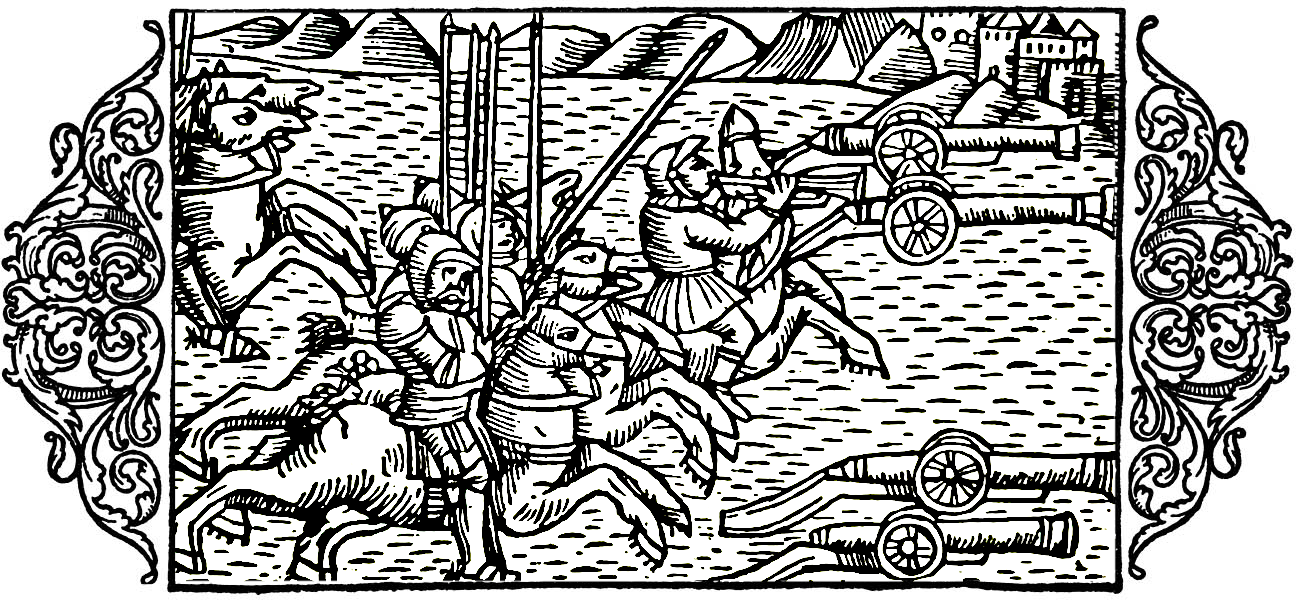
A battle fought on the frozen sea ice outside of Stockholm in 1465. Compilation from Olaus Magnus, Description of the Northern Peoples, 1555
Introduction
In this module students learn about the impacts of the Little Ice Age—both common hazards such as food shortages and epidemics well as complex risks such as conflict and economic depression. Many of these consequences remain relevant today, inviting comparisons between the effects of the LIA and the challenges of global warming.
Presentation
Questions and Answers
Show answer Hide answer
During late medieval and early modern times, agriculture in the Nordic countries was very sensitive to the weather and the cycle of the seasons (see Lesson 3). The generally colder, less predictable seasons of the LIA were worse for most farmers. Nevertheless, the risks to agriculture depended a lot on local practices and conditions. Colder summers and shorter growing seasons reduced grain harvests all across the Nordic countries, but especially in more northern, inland, and upland regions. In these regions, crops were at more risk from early and late frosts as well as shorter summers and longer winters, which didn’t leave enough time to gather sufficient hay for animals. In warmer regions, particularly southern Sweden, summer drought could also be a risk.
Show answer Hide answer
First, when people and animals are together indoors during the winter, they are more likely to spread diseases. We see that effect even today when colds, influenza, COVID and other respiratory diseases infect more people during the winter “flu season.” During late medieval and early modern times, people could also infect each other through shared fleas and lice, which spread diseases such as typhus. This was often the case when poorer people had to live in cramped conditions or needed to huddle together for warmth, welfare or shelter. Second, the LIA affected food production (see above). When people are malnourished or face vitamin deficiencies, their immune systems are weaker. Cold and malnourished people during bad years of the LIA were therefore more likely to fall sick from common infections. Third, this was a period before refrigeration and other modern forms of food storage. People used techniques such as smoking, salting, pickling, and fermenting. Nevertheless, long winters without fresh produce meant more risk of sickness from moldy, rotting, or contaminated foods. Finally, during years of famine, people were more likely to move in search of help. These famine refugees faced terrible circumstances including poor clothing, lack of shelter, and lack of sanitation. The worst outbreaks of diseases such as typhus, typhoid, dysentery, and plague during early modern times were often spread by these famine conditions. The fact that some of these famines occurred during wars made the impacts even worse (see Lesson 4).
Show answer Hide answer
Probably not. Although cooling was an especial hardship for people in the North, what really made the LIA such a challenge was change and unpredictability. It took a long time before people in the Nordic countries developed the science, technologies, and institutions they needed to better understand climate and weather and to develop effective policies and responses (see Lesson 5). As late as the 1800s, the LIA could still deliver unexpected disasters.
Today, modern science, technologies, and institutions mean that we are better able to respond to challenges of climate change and even take advantage of some aspects of global warming. Warmer summers could help boost grain production and support new crops. Arctic shipping lanes will open, generating new economic opportunities.
Nevertheless, on balance, global warming will almost certainly do more harm than good, even in the North. Nordic countries will need to build and adapt expensive infrastructures for hotter summers, stronger precipitation and rising seas. We’ll face new hazards, including more invasive pests and weeds, heavier storms and hail, and more forest fires. Changing seasons will threaten our cultural heritage and seasonal traditions. Moreover, the Nordic countries will face the effects of disasters related to climate change around the world: overseas famines, conflicts, displaced populations, as well as economic and political turmoil will have impacts here, too. (See Lesson 6 for more on this topic.)
Activities
1. Comparing past and future climate change and hazards.
The Intergovernmental Panel on Climate Change brings together scientists from around the world to report on climate change and its impacts and to advise countries about what to expect and how to adapt. The most recent (sixth) assessment report includes the
IPCC WGI Interactive Atlas:
a toolbox to explore projected climate changes and hazards in each world region. First, use the “Climate Futures” tool to explore expected temperature changes for Northern Europe. How fast is the temperature expected to change in the coming decades? How does this temperature change compare to the variations in temperature during the Little Ice Age? Second, use the “Regional Synthesis” tool to explore trends in climate-related hazards in Northern Europe. What kind of hazards is global warming expected to bring to the Nordic countries? How do these compare to the hazards faced by Nordic societies during the Little Ice Age?
2. Impacts of climate variability and weather on daily life.
Search recent local news for examples of climate- and weather-related hazards. Based on these reports, what types of hazards cause the greatest impacts? How do these impacts on contemporary Nordic populations compare to those of the Little Ice Age? How have our exposure and vulnerability to meteorological hazards changed since early modern times?
Videos
In this video, we interview climate historian Heli Huhtamaa about Finland's famines during the LIA and what they tell us about exposure, vulnerability, and adaptation in the face of climate change.
Further Readings and References
Arkivverket Norge: Norge i 1743. Web exhibition (in Norwegian)
Benedictow, Ole. “Demographic Conditions.” In The Cambridge History of Scandinavia: Volume 1: Prehistory to 1520, edited by Knut Helle, 1:235–49. Cambridge: Cambridge University Press, 2003. https://doi.org/10.1017/CHOL9780521472999.015.
Chen, Tzu Tung, Rodney Edvinsson, Karin Modig, Hans W. Linderholm, and Fredrik Charpentier Ljungqvist. “Climatic Impacts on Mortality in Pre-Industrial Sweden.” Climate of the Past 21, no. 1 (January 27, 2025): 185–210. https://doi.org/10.5194/cp-21-185-2025.
Damm, Carina. “Volcanic Vulnerability in Medieval Iceland.” In Nordic Climate Histories: Impacts, Pathways, Narratives, edited by Dominik Collet, Ingar Mørkestøl Gundersen, Heli Huhtamaa, Fredrik Charpentier Ljungqvist, Astrid E.J. Ogilvie, and Sam White. White Horse Press, 2025. https://www.whpress.co.uk/publications/2025/05/02/nordicclimatehistories/.
Collet, Dominik, and Maximilian Schuh. Famines During the ʻLittle Ice Ageʼ (1300-1800): Socionatural Entanglements in Premodern Societies. Springer, 2018.
Dybdahl, Audun. “Climate and Demographic Crises in Norway in Medieval and Early Modern Times.” The Holocene 22 (2012): 1159–67.
Edvardsson, Ragnar, William P. Patterson, Hlynur Bárðarson, Sandra Timsic, and Guðbjörg Ásta Ólafsdóttir. “Change in Atlantic Cod Migrations and Adaptability of Early Land-Based Fishers to Severe Climate Variation in the North Atlantic.” Quaternary Research 108 (July 2022): 81–91. https://doi.org/10.1017/qua.2018.147.
Geirsdottir, Aslaug, David J. Harning, Gifford H. Miller, John T. Andrews, Yafang Zhong, and Chris Caseldine. “Holocene History of Landscape Instability in Iceland: Can We Deconvolve the Impacts of Climate, Volcanism and Human Activity?” Quaternary Science Reviews 249 (2020): 106633. https://doi.org/10.1016/j.quascirev.2020.106633.
Gissel, Svend, Eino Jutikkala, Eva Österberg, Jørn Sandness, and Björn Teitsson. Desertion and Land Colonization in the Nordic Countries c.1300-1600: Comparative Report from the Scandinavian Research Project on Deserted Farms and Villages. Stockholm: Almqvist & Wiksell International, 1981.
Holopainen, Jari, and Samuli Helama. “Little Ice Age Farming in Finland: Preindustrial Agriculture on the Edge of the Grim Reaper’s Scythe.” Human Ecology 37 (2009): 213–25.
Huhtamaa, H., S. Helama, L. Leijonhufvud, and F. Charpentier Ljungqvist. “Combining the Archives of Nature and Society: Tree Rings and Tithes.” Past Global Changes Magazine 28 (2020): 50–51. https://doi.org/10.22498/pages.28.2.50.
Huhtamaa, Heli, and Fredrik Charpentier Ljungqvist. “Climate in Nordic Historical Research – a Research Review and Future Perspectives.” Scandinavian Journal of History 46, no. 5 (October 20, 2021): 665–95. https://doi.org/10.1080/03468755.2021.1929455.
Kiss, Andrea, and Kathleen Pribyl, eds. The Dance of Death in Late Medieval and Renaissance Europe: Environmental Stress, Mortality and Social Response. New York: Routledge, 2020.
Lappalainen, Mirkka. “Death and Disease During the Great Finnish Famine 1695–1697.” Scandinavian Journal of History 39 (2014): 1–23. https://doi.org/10.1080/03468755.2014.937740.
Ogilvie, Astrid E.J., and M.W. Miles. “Northern Iceland Temperature Variations and Sea-Ice Incidence c. Ad 1600–1850.” In Nordic Climate Histories: Impacts, Pathways, Narratives, edited by Dominik Collet, Ingar Mørkestøl Gundersen, Heli Huhtamaa, Fredrik Charpentier Ljungvist, Astrid E.J. Ogilvie, and Sam White. White Horse Press, 2025. https://www.whpress.co.uk/publications/2025/05/02/nordicclimatehistories/.
Orrman, Eljas. “Growth and Stagnation of Population and Settlement.” In The Cambridge History of Scandinavia: Volume 2: 1520–1870, edited by E. I. Kouri and Jens E. Olesen, 2:135–75. Cambridge: Cambridge University Press, 2016. https://doi.org/10.1017/CHO9781139031639.011.
Post, John. Food Shortage, Climatic Variability, and Epidemic Disease in Preindustrial Europe. Cornell University Press, 1985.
White, Sam. “A Model Disaster: From the Great Ottoman Panzootic to the Cattle Plagues of Early Modern Europe.” In Plague and Contagion in the Islamic Mediterranean, edited by Nükhet Varlik. Arc Humanities Press, 2017. https://doi.org/10.1017/9781942401162.005.